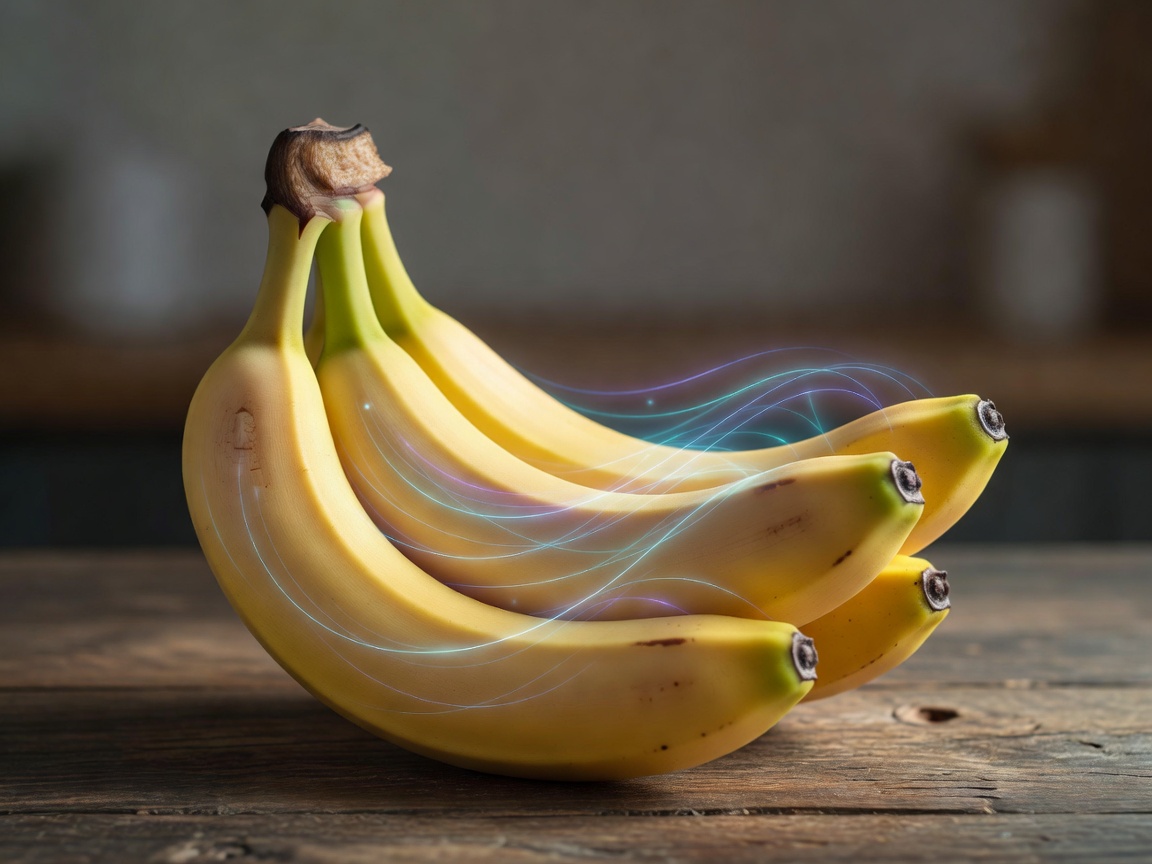
Next time you slice a fresh yellow Cavendish banana over your morning bowl of granola, remember this staggering truth: you are sprinkling your breakfast with a measurable amount of radioactive decay. In fact, bananas are so reliably radioactive that nuclear physicists created a colloquial measurement unit known as the BED (Banana Equivalent Dose).
The Culprit: Potassium-40
Bananas are famous for being packed with potassium, an essential nutrient necessary for nerve transmission, muscle contractions, and fluid balance. What nutritional labels rarely mention is that roughly 0.012% of all naturally occurring potassium on planet Earth exists in the form of Potassium-40 (⁴⁰K), a primordial radioactive isotope with an unfathomable half-life of 1.25 billion years.
Should You Panic and Throw Away Your Fruit?
Absolutely not! The radiation dose from eating one single banana is roughly 0.1 microsieverts (0.1 µSv). To put this tiny number in scientific perspective:
- Living on Earth gives you a natural background cosmic radiation dose of approximately 10 µSv every day.
- A standard chest X-ray delivers roughly 100 µSv (equivalent to munching 1,000 bananas at once).
- A transcontinental flight from New York to London exposes you to roughly 40 µSv due to high-altitude solar radiation.
- You would need to eat roughly 10 million bananas in a single sitting to experience acute fatal radiation poisoning. At that stage, your stomach would rupture before any isotope could cause cellular harm.
The Real-World Border Security Problem
While harmless to human tissue, the radiation is real enough to cause massive headaches for international maritime logistics. Massive cargo container ships carrying thousands of tons of fresh bananas regularly trigger sensitive radiation detection portals at customs checkpoints in ports such as Rotterdam, Long Beach, and Singapore.
Customs officers must calibrate their gamma-ray spectrometers to distinguish the natural isotopic signature of innocent bananas from illicit radioactive materials such as Cesium-137 or enriched uranium.